After 5 Losses in a Row on Roulette the Next Bet Won 48.70% of the Time. The Exact Chance: 48.65%
"It has to turn now" is the most expensive sentence in gambling. We recorded what happened after every losing run in 5,000,000 rounds.
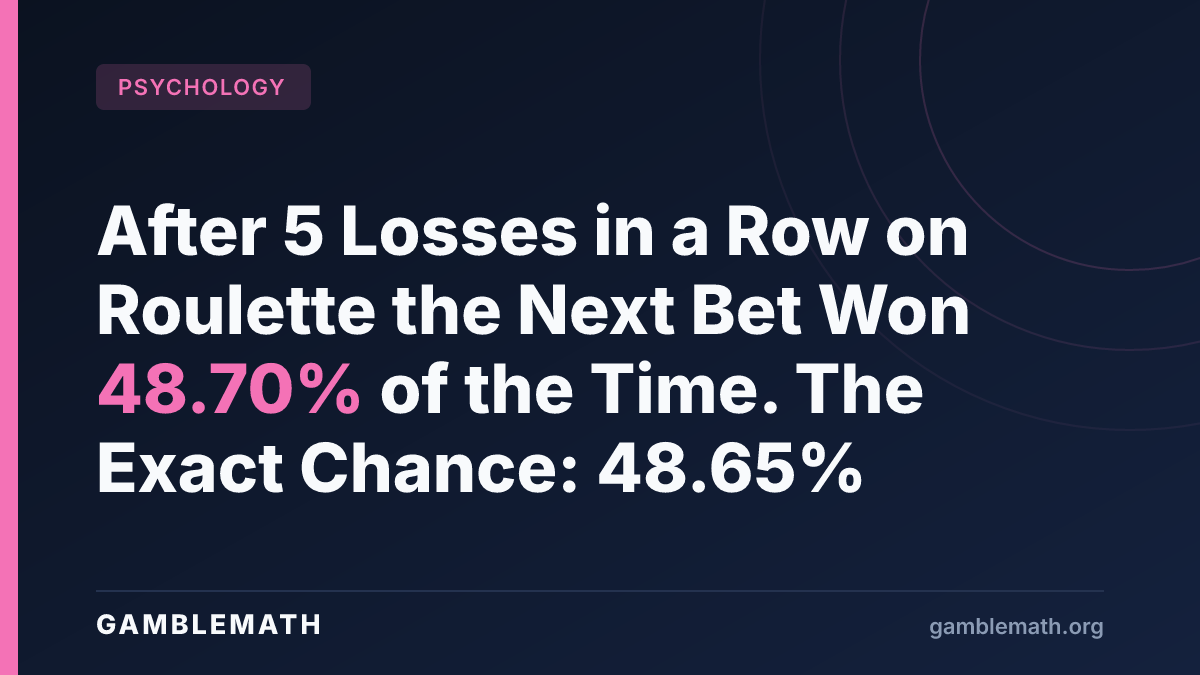
The simulation of 5,000,000 spins shows no statistical edge after a losing run, and even after eight or ten consecutive losses the win share stays within normal variance.
The expected loss per spin stays the same, and the bankroll risk only grows when you chase.
- Across 5,000,000 simulated spins, red/black won 48.67% of the time, versus the exact 48.65% chance.
- After five or more consecutive losses (178,944 cases) the next bet won 48.70%, within a ±0.30% margin.
- After eight or more losses (24,225 cases) the win share was 49.09%, within a ±0.83% margin.
- After ten or more losses (6,353 cases) the win share fell to 48.20%, within a ±1.62% margin.
- The longest losing streak observed was 22 spins; a ten-loss streak appears with 26.4% probability within 500 spins and 95.6% before 5,000 spins.
The belief, and how we tested it
To test that, we ran 5,000,000 simulated rounds of red or black on a single-zero wheel. Across the whole dataset the bet won 48.67% of the time while the exact chance of a win on any spin is 48.65%.
We then isolated the moments that followed a losing run. Immediately after five or more losses, which happened 178,944 times, the next bet won 48.70% of the time; a share measured on that many cases can sit 0.30 percentage points either side of the exact 48.65% by chance alone. After eight or more losses, which happened 24,225 times, the next bet won 49.09%, a margin of 0.83 points. After ten or more losses, which happened 6,353 times, the next bet won 48.20%, a margin of 1.62 points.
The simulation also shows that long losing runs are ordinary. The longest run observed was 22 losses in a row. A run of ten losses turns up within 500 rounds of this bet with probability 26.4%, and within 5,000 rounds with probability 95.6%. At all eight streak lengths we checked, the measured share stayed inside the margin around the exact 48.65%, confirming that the outcome of a round does not depend on the rounds before it.
After five, eight and ten losses
A run of five losses, eight losses or ten losses offers the same statistical footing as any other spin. In the 178,944 cases where five or more losses preceded the next bet, the share of wins was 48.70% and the 99% margin of chance was ±0.30 percentage points. When the streak reached eight or more losses, the sample shrank to 24,225 instances; the share of wins rose to 49.09% with a margin of ±0.83 points. For ten or more consecutive losses the data set contained 6,353 cases, the win share fell to 48.20% and the margin widened to ±1.62 points.
Each of those three measured shares sits inside its respective margin, meaning the outcome of the next spin never strayed beyond what chance alone permits.
Raising the stake after a losing run does not lift the chance of the next win; it only raises the amount lost if the run continues, and the run continues exactly as often as it would at any other moment. Consequently, the probability of a win after any length of losing streak stays anchored at the exact 48.65%.
The data confirm that the spin’s odds are unchanged, no matter how deep the losing run runs.
Long losing runs are ordinary
The simulation produced a single streak that stretched to 22 consecutive losses, the longest run observed across all 5,000,000 spins. That extreme is not a fluke; it sits at the tail of a distribution that regularly generates much shorter, but still significant, sequences.
A run of ten losses in a row appears with probability 26.4% within the first 500 spins and with probability 95.6% before the 5,000-spin mark. Those odds mean that, in any modestly sized session, you should expect to encounter a ten-loss streak at least once.
Because each spin is independent, the chance that the next bet wins after a ten-loss streak stays close to the baseline. The streak does not tilt the odds in either direction.
The practical upshot is simple: a bankroll must survive runs that are statistically inevitable. Raising the bet after a streak does not improve the win probability; it only amplifies the loss if the streak continues.
Recording streak lengths lets you measure exactly when the inevitable run hits and adjust your play accordingly.
What raising the stake after a run does
Raising the stake after a losing run does not alter the probability that the next spin will be a win. The exact chance of a win on a single-zero wheel stays at 48.65 percent, regardless of how many losses have just occurred.
The measured shares after long losing streaks illustrate this stability. After five or more losses the next bet won 48.70 percent of the time; after eight or more losses it won 49.09 percent; after ten or more losses it won 48.20 percent. Each figure sits well inside the statistical margin that surrounds the exact 48.65 percent, confirming that the run length does not shift the odds.
Because the odds are unchanged, the continuation of the run is unchanged as well. The run continues exactly as often as it would at any other moment, meaning the probability that another loss follows a loss-streak remains the same as after a single loss. The longest observed losing run of 22 consecutive losses occurred under the same odds as any shorter run.
What does change when the stake is increased is the size of the loss if the run persists.
The odds themselves stay fixed at 48.65 percent per spin.
A losing streak does not change the 48.65% chance of winning the next red/black spin.
The data behind this piece
Every figure in the text comes from the runs below. They are computer simulations and exact calculations, not real-money play, and they can be reproduced: the model parameters are stated and the random seed is fixed.
Does a losing run make a win more likely? (red or black on a single-zero wheel)
How we ran it: 5,000,000 simulated independent rounds of red or black on a single-zero wheel (win chance 48.65%). Before every round we record the length of the current losing run, then whether the round won. Random seed: 37913
| Losses in a row just before | Times this happened | Next bet won | Exact chance | Margin of chance (99%) |
|---|---|---|---|---|
| 3 or more | 676,540 | 48.59% | 48.65% | 0.16 points |
| 4 or more | 347,822 | 48.55% | 48.65% | 0.22 points |
| 5 or more | 178,944 | 48.70% | 48.65% | 0.30 points |
| 6 or more | 91,799 | 48.52% | 48.65% | 0.42 points |
| 7 or more | 47,254 | 48.73% | 48.65% | 0.59 points |
| 8 or more | 24,225 | 49.09% | 48.65% | 0.83 points |
| 10 or more | 6,353 | 48.20% | 48.65% | 1.62 points |
| 12 or more | 1,731 | 48.24% | 48.65% | 3.09 points |
Questions players ask
Does a losing streak increase my chance of winning the next roulette spin?
No, the chance stays at about 48.65%; after five losses it's 48.70%, after eight losses 49.09%, after ten losses 48.20%, all within statistical margin. Whether you have lost five, eight, or ten times in a row, the next spin wins roughly half the time, and the small differences are just random noise.
How often will I see a run of ten consecutive losses in roulette?
In the 5,000,000-spin simulation a ten-loss streak appears with a 26.4% probability within the first 500 spins and a 95.6% probability before 5,000 spins, meaning it is almost certain to occur during a typical session of a few thousand spins.
If I double my bet after a losing streak, will I win more often?
No. Raising the stake does not affect the underlying 48.65% win probability; the simulation shows the same win share after five, eight or ten losses.
What is the longest losing streak I could expect in a long roulette session?
The 5,000,000-spin model recorded a maximum losing run of 22 consecutive reds or blacks. Such extreme streaks sit in the tail of the distribution, but they occur naturally and do not alter the odds of the next spin, which remain at 48.65%.